
Cross Talk
On Christ’s last words, then and now

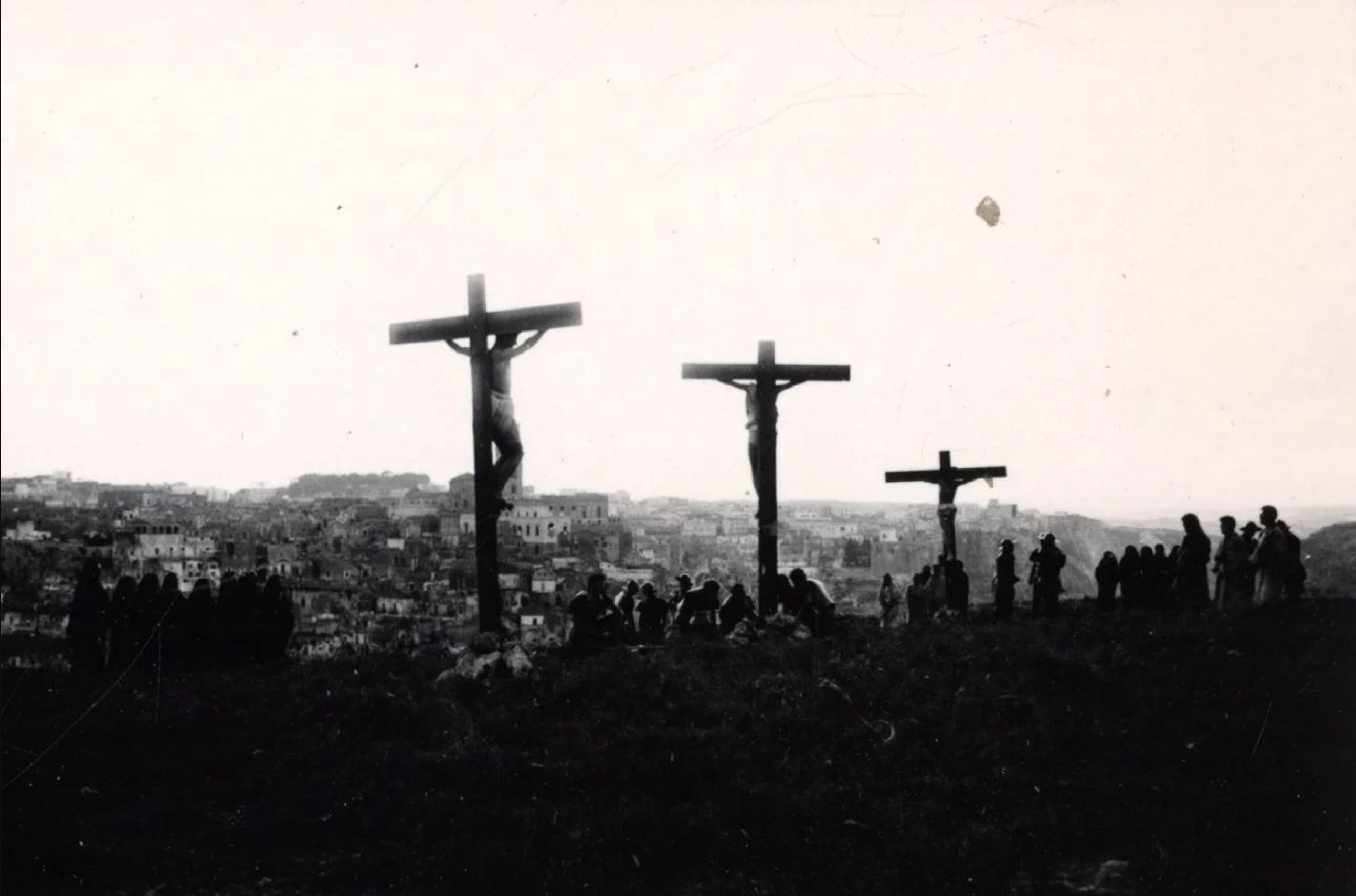
Questionable cover art aside, this is a compelling essay by Frederica Mathewes-Green, who begins by observing that people who are ill- or preliterate tend to name prayers and poems by their first line. For example, what Protestants call “the Lord’s Prayer,” Catholic and Orthodox Christians, coming out of a preliterate tradition, call “the Our Father.”
Not only had I never considered this, but I think it’s clear that the preliterate convention is both more natural and more useful: the informal shorthand becomes the formal title, similar to how nicknames or metonyms work, while also doubling as a mnemonic device. That is, if you can remember the name, you can remember the first line, and if you can remember the first line, you’re more likely to remember the second — etc. Medieval hymnodists called this method incipit. The Shema, from the book of Deuteronomy, is one of the oldest examples of using the first word as a name: “Shema Yisrael, Adonai Eloheinu, Adonai Echad!”1 More modern, secular examples run the gamut from nursery rhymes to the Pledge of Allegiance to the work of Emily Dickinson. Lacking any published titles, what else should we call “I heard a fly buzz when I died” or “After great pain, a formal feeling comes”? Poems 479 and 372 don’t quite land the same.
And yet that’s the way most Christians name the psalms — by number. The practical issues with this are obvious. How many people know the contents of, say, Psalm 19 or Psalm 137 off the top of their head? The names don’t transmit any information. But if I read you the opening lines there’s a chance you might remember the rest, or at least intuit the gist: “The heavens declare the glory of God” (19); “By the rivers of Babylon we sat and wept” (137).2 Psalm 23 is probably the only psalm that a meaningful amount of people might recall by its opening line, “The LORD is my Shepherd; I shall not want.”
Still, to return to Matthewes-Green’s essay, it’s the psalm immediately preceding Psalm 23 that reveals the extent of the problem. What we blandly call Psalm 22 a first-century Palestinian Jew would’ve called “My God, my God, why have you forsaken me?” Now, even if a contemporary Christian recognizes those words as the same ones which Christ utters from the cross — his last, according to the Gospels of Matthew and Mark — and even if they also know that Christ is actually invoking scripture — many do not3 — the tendency of our literate culture is to read those words as a standalone sentence; that is, to assume that Jesus is reciting a single line. But a preliterate person would’ve understood those words not as a quote but a title. Where we assume a select part, a preliterate person would’ve interpreted Jesus’ cry in reference to the whole psalm, which is important — because while the psalm begins in lamentation, it ends on a far more triumphant note:
All the ends of the earth shall remember
and turn to the LORD;
and all the families of the nations
shall worship before him.
For dominion belongs to the LORD,
and he rules over the nations.To him, indeed, shall all who sleep in the earth bow down;
before him shall bow all who go down to the dust,
and I shall live for him.
Posterity will serve him;
future generations will be told about the Lord,
and proclaim his deliverance to a people yet unborn,
saying that he has done it.
The end of the NIV translation is even more emphatic:
They will proclaim his righteousness,
    declaring to a people yet unborn:
    He has done it!
Two questions should be asked at this point, one of which is obvious. Assuming you didn’t already know about preliterate naming conventions, does this change the way you think about Christ’s last words? It does for Matthewes-Green, and factoring in a few caveats, it does for me too.
More on that in a bit, though. First I want to explore a more practical question Matthewes-Green doesn’t ask: how did Jesus’ peers know all of Psalm 22? There are 150 psalms in the Hebrew Bible. Psalm 22 is striking, but also pretty conventional as far as lamentations go. It’s not part of the daily liturgy cycle, nor is it a traditional reading for any of the major Jewish festivals.4 More pointedly, as Matthewes-Green emphasizes, most of these people couldn’t read. So, how would a preliterate person attain such deep biblical literacy in a way that a literate person today, even a person of faith, typically can’t?
I suspect the conventional answer would be something like, “they were more religious than we are.” Which isn’t wrong, per se, but also doesn’t identify a specific mechanism.5 Instead, let’s go back to the idea of names-as-mnemonic-devices and reframe the question this way: what if a preliterate person could remember Psalm 22, and in fact vast quantities of scripture, precisely because they couldn’t read? Because memorization, or being “off-book,” was the only option?
In other words, I think Matthewes-Green is making a category error. The core insight of her essay is correct, but framing the argument exclusively around literacy and illiteracy only tells half the story. The more accurate and revealing distinction, to borrow from Walter Ong, would be between literacy and orality — and the upside of orality is something like total recall. (I jest, but only a bit.) Where our culture is based on the written word, first-century Palestine was based on the spoken word, and for the spoken word to be preserved, it needed to be repeated over and over in song, poetry, myth, and all the other kinds of stories which eventually were recorded as scripture, and later still, “the Bible.”
What this means is that preliterate culture — which I’ll now call oral culture — had a distinct advantage. As a literate culture, our ability to commit large amounts of information to memory is limited; memory requires practice, and there’s little incentive to practice when information can be collected and stored for later use. Plato’s argument in the Phaedrus follows a similar logic, as do current debates around AI and “de-skilling.” Where we mediate and codify knowledge through reading and writing, oral culture uses memory and speech. Where orality enables depth and focus, literacy prioritizes breadth and diversity. Literacy allows us to “look stuff up”; or, as some over-caffeinated French philosophers figured out in the eighteenth century, literacy creates the potential for encyclopedic knowledge, which is different both in nature and purpose from knowledge acquired by tradition (the way most learning took place before the printing press).6 Encyclopedic learning is procedural; what matters is the ability to apply knowledge as a means to an end — think scientific method. Meanwhile tradition as a practice tends to be more focused and teleological; for example, the cultivation of virtues or crafts.
These are sweeping generalizations. For our purposes, the key way literate and oral cultures differ is illustrated by the proverb of the fox and hedgehog: if a person in 2026 CE knows a little about a lot, a person in 33 CE knew a lot about a little.
Moving on to what all this means.
As Matthewes-Green shows, the oral tradition provides a much wider window through which to contemplate and discern the cross. The question is whether the window changes what we see. Knowing that the crucified Jesus invokes a psalm which culminates in deliverance — “he has done it!” — should that change the way we interpret the so-called cry of dereliction? Or is that term a misnomer? Are Christ’s last words a cry of despair in which the Son experiences the Father’s abandonment, or do they anticipate the final triumph and reconciliation of God’s creation? Is this a cry of victory or defeat?
That may sound strange or disingenuous. If the resurrection is true, then God has triumphed over sin and death. Alternatively, as Paul says, “If Christ has not been raised, your faith is futile and you are still in your sins.” But Christian faith bears witness to both the resurrection and the crucifixion. At the same time Paul celebrates Christ’s victory he insists, “we preach Christ crucified.” This is the mystery, then: Christianity attests to victory and what Tolkien called “the long defeat.” Both have to be confronted, discerned, and taken up. Both make up the paradox in which the Christian faith is enjambed. On its own, resurrection is an archetype. It was a common belief among Jews and pagans alike in the first century, and would’ve been expected of any messiah. Crucifixion, on the other hand, was unconscionable. Deuteronomy declares “anyone hung on a tree is under God’s curse.” Roman citizens, for their part, didn’t even like to say the word out loud: it wasn’t something polite people talked about. This is why Paul says that the cross is a scandal to anyone who purports to be religious and downright nuts to anyone who aspires to be an intelligent and respectable member of society.
So, again, the Christian faith is founded on a severe tension — even problem, if we’re bold enough to call it that. There is no way to claim Christ is victorious without also saying his victory depends on a hideous and defiling form of execution — administered by the state, made possible by the overt or otherwise listless collaboration of his friends — which not only would’ve been considered a religious abomination, but which failed to materially improve the political, economic, or social conditions of his followers. Even acknowledging Christ’s death as the ultimate act of self-sacrifice, a more practically-minded critic might echo a line from Richard II: “That were some love, but little policy.” The scandal and the folly are permanent.
I say all that not to be morbid, much less to sound more certain than I am, but as a corrective to what I see as Matthewes-Green’s overemphasis on the the Christus Victor theme to the diminishment of Christ’s agony and death. “This [the crucifixion] was the plan laid from the foundation of the world, and not a surprise” — yes. The cross is not God’s emergency failsafe. But then she goes on, “it was not possible for the Son of God to doubt whether he would be saved” — perhaps. But that’s a separate Christological assertion, and in the immediate context of the scene of the crucifixion, an abstraction. I don’t think it can be deduced from Christ’s reference to Psalm 22, as she suggests. The psalm may end in faithful confidence, but considered as a whole — which is what Matthewes-Green is arguing for — its form and content are like something out of a surrealist Buñuel film, full of fear, anxiety, and physical humiliation, in which the speaker compares himself to “a worm, and not human,” whose bones are out of joint and whose mouth is “dried up like a potsherd.” In short, Psalm 22 can’t be reduced to a happy ending. It is an extended back-and-forth between anguish and hope, lamentation and deliverance.
As for the larger question concerning Christ’s nature, if it is impossible for Jesus to doubt, what would that say about the humanity of Jesus? Does it diminish or even neuter the faith he displays, especially in the Passion Narrative? He clearly wrestles with uncertainty in the hours leading up to his arrest, asking God in Gethsemane whether it is possible to “remove this cup” — that is, avoid his fate — and praying with such fervor that his sweat becomes “like great drops of blood falling down on the ground.” If this isn’t doubt, what is?
These are two-thousand-year-old questions that exceed the scope of this post (!). But in the same way Matthewes-Green corrects an interpretation of Christ’s last words that’s overly negative or ahistorical, we should also avoid a reading which is overly rosy or transhistorical. For me anyway, recognizing that kind of deep, through-a-glass-darkly ambiguity is more honest and even, oddly enough, encouraging. God, too, knows suffering, fear, doubt, and death. His victory is inseparable from his solidarity — Immanuel, God with us.
Consider also how the people of the Torah are especially concerned with what to name God. Sometimes an explicit name is given, sometimes nicknames, titles, or abbreviations emerge — i.e., YHWH — and sometimes names are confused, conflated, or misused.
The first I selected as a reading at my marriage. The second appears across countless songs, poems, novels, and even an episode of Mad Men. I had to look the up the “titles” of both.
In fact, according to tradition, Christ is reciting the words of his direct ancestor, David.
I’m admittedly out of my depth here but think I’m justified. Psalm 22 was known as a messianic psalm, but only gained notable attention from Jewish scholars after the emergence of Christianity (in part to reclaim its Jewishness). The one holiday exception I can find is that some portions are occasionally read for Purim.
It’s not wrong, but it’s not exactly right, either. Even if conventional wisdom indicates that people two thousand years ago were simply more religious than they are today, religiosity is very different than knowing and understanding the contents of a professed religion. Besides, some of the most famous stories in scripture are either about people who are remarkably impious or irreligious, or about people whose piety is a sham. Jesus himself operated within a prophetic Jewish tradition that critiques religion.
What we can say is that, especially for the early Jewish followers of Jesus, “My God, my God, why have you forsaken me?” would’ve instantly evoked a specific, historically contingent concentration of meaning, emotion, and cultural memory that’s impossible for us to understand or reproduce in full. (Even the most fervent scholar of Biblical Studies is forced to admit theirs is a fundamentally lo-fi endeavor.)
Tradition, from the Latin tradere, meaning to pass down or give for safekeeping.